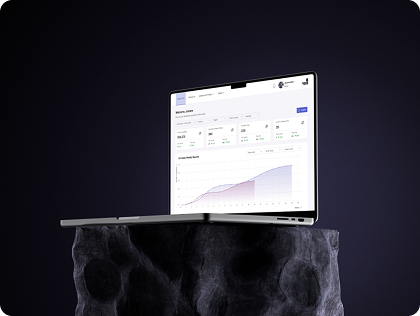
MEConnects: Architecting a Governed B2B Procurement Marketplace
Transitioning an unmoderated 14M-record legacy directory into a high-trust, human-in-the-loop executive meeting platform.
Product StrategySystem Logic & ArchitectureDigital TransformationMulti-Portal Ecosystem
Role & Scope
- Lead/Senior UX Designer
- System Strategy & Service Architecture
- Multi-Portal Ecosystem & IA
Target users
- Enterprise Buyers (C-Suite)
- Verified Sellers (Vendors)
- Internal Directors (Concierge Ops)
Scale & Tech Context
- 3 multi-role Portals
- 14M Historical Backend Records
- 420-Token Design System
Product Team
- Hybrid Agile Squad
- 1 Product manager, 2 Engineering Lead, & 2 Operational Head
Duration
- 8 Months
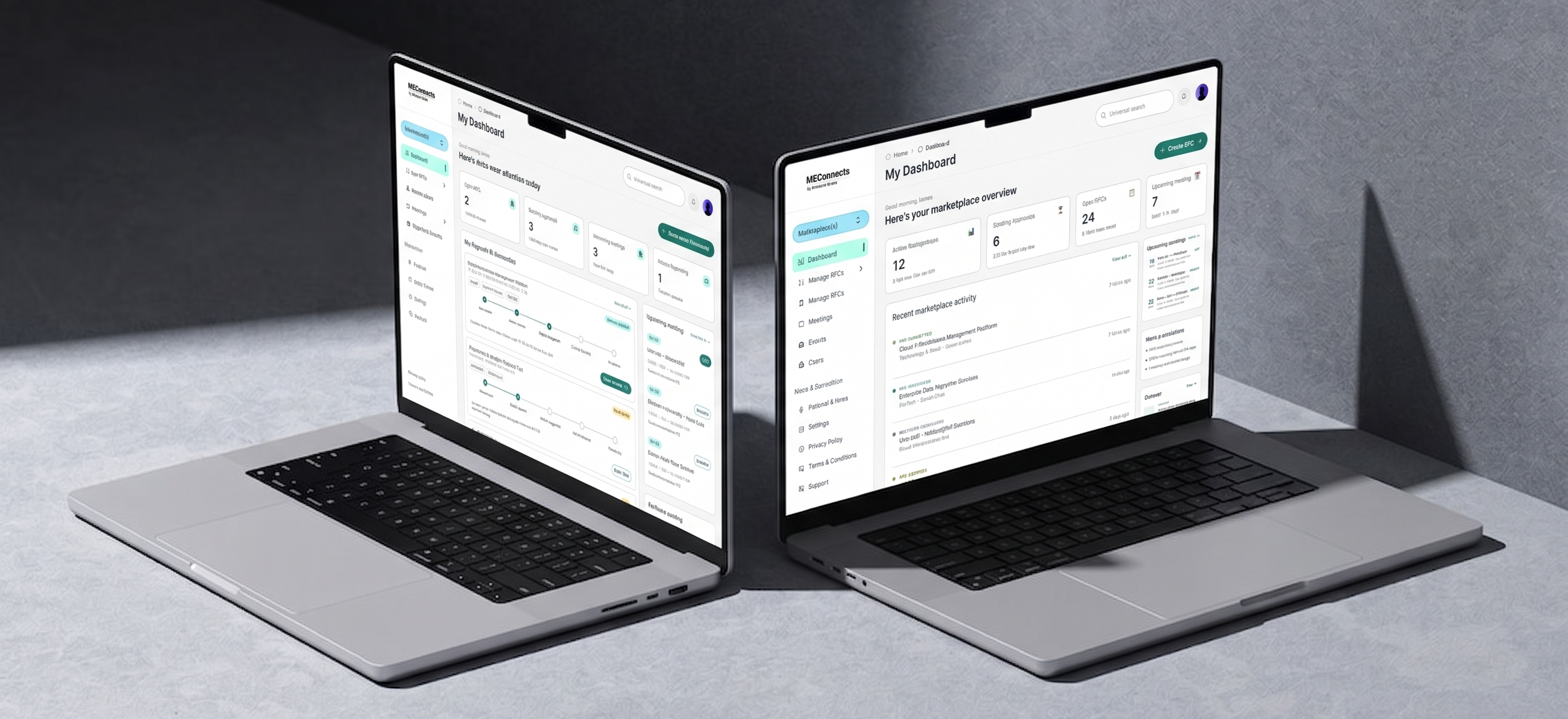
Marcus Evans
Digitising summits, not building heavy ERPs
Marcus Evans is a global leader in premium executive summits, bringing Executive buyers and enterprise vendors together for private, pre-qualified business meetings.
Unlike heavy procurement platforms (like SAP Ariba or Coupa) that manage complex contract arbitration and cross-border tax terms, our strategic mandate was to digitize the summit experience. We focused on guaranteeing verified executive meetings and connection feasibility without burdening users with ERP-level administrative complexity.
The Problem
The unmoderated directory was failing
The legacy platform operated as an open, unmoderated directory. Enterprise buyers were anxious about corporate privacy leaks, vendors were exhausted by repetitive blind bidding, and internal operations teams spent over 60% of their week manually copying email requests.
This lack of governance caused turnaround to drag out to 30 days, and 68.5% of high-value negotiations leaked off-platform into private, untracked email chains.
Impact
Measuring success, by the numbers
8 months later, the governed MEConnects platform connected 3 multi-role portals to a 14M-record database, replacing offline email chaos with a 4-day maximum meeting cadence
INTAKE SPEED
< 3 MIN
Tested task time (down from 30m)
OPERATIONAL SLA
< 2 DAYS
Target turnaround SLA (down from 7-30 days)
RELEVANCE
> 70%
Director validation (vs. <20% baseline)
GOVERNANCE
100%
Closed-loop workflow
STRATEGIC SCOPE
Defining the platform boundary
| Strategic Vector | Heavy Enterprise ERPs (SAP Ariba, Coupa) | MEConnects (Executive Concierge Model) |
|---|---|---|
| Legal Scope | Manages full contracts & assumes outcome liability | Zero outcome liability; guarantees verified meeting delivery |
| Primary Value | Invoicing, legal processing & compliance auditing | Feasibility checks, executive privacy, & curated matchmaking |
| Time to Value | 6–12 months of complex company-wide rollout | Instant browser access for active summit delegates |
| Matching Logic | Unmoderated catalog search & blind bidding | Curated human-in-the-loop review & tiered recommendations |
Ecosystem Discovery
Why the open directory was failing
Auditing 140+ transaction logs and interviewing participants across all three user groups revealed why the legacy platform was leaking high-value enterprise deals. Rather than a lack of market access, the platform suffered from a breakdown of trust, privacy, and operational clarity.
Demand Side
Enterprise Buyer
“Why am I being forced to answer 35 generic, mandatory questions? Open text boxes feel legally unsafe and vague. It is much easier to just email my account rep directly.”
The Privacy Deficit (78.4%)
- Feared intellectual property and budget exposure from open-text fields.
- Skipped self-serve request creation entirely to protect corporate anonymity.
Operations
Internal Director
“Buyers bypass the portal and ask us to post requests for them. We spend 60%+ of our working week acting as manual data-entry clerks and chasing vendors across inboxes.”
The Shadow Concierge Bottleneck
- 60%+ of operational capacity consumed by manual email chasing and forwarding.
- Lack of centralized tracking dragged deal cycles out to 30 days.
Supply Side
Verified Seller
“We spend days crafting technical pitch documents. Forcing us to re-type that same information into endless form fields is double work when we don't even know if the buyer is serious.”
Double-Work & Blind Bidding
- Hesitated to invest proposal effort without verified budget and timeline signals.
- Experienced high drop-off due to unmoderated, blind request specifications.
Systems Architecture
Tokenized taxonomy & the matching engine
To eliminate the open-field ambiguity that frustrated enterprise buyers and broke database indexing, we structured platform intake around a standardized enterprise taxonomy mapped to Marcus Evans' Product and Services Index (PSI) and a 14-million record historical database.
DATA MAPPING
Translating UI Inputs into Algorithmic Logic
| Parameter Dimension | UI Input Method | Backend Schema & Algorithmic Impact |
|---|---|---|
| Product & Services Index (PSI) | Hierarchical taxonomy selector | Hard Filter: Categorizes technical and service capabilities across 12 sectors. |
| Investment Size | Standardized budget band chips | Binary Threshold: Matches buyer project scope against verified vendor operational capacity. |
| Investment Horizon | Deployment milestone selectors | Cadence Scoring: Synchronizes vendor onboarding cycles with the buyer's procurement target dates. |
| Geographic Region | Multi-region territory tags | Compliance Filter: Enforces cross-border locality constraints and regional trade regulations. |
| Corporate Anonymity | Global state-driven toggle | Sanitization Layer: Automatically strips corporate branding and masks email domains at the database level. |
Workflow Architecture
Translating governance into human workflows
Solving systemic marketplace leakage required moving beyond generic forms. We engineered two dedicated operating environments: a zero-trust structured intake flow for enterprise buyers and a split-pane triage desk for Marcus Evans operations directors.
DEEP DIVE 01 · DEMAND SIDE
The Buyer Zero-Trust Ingestion Engine
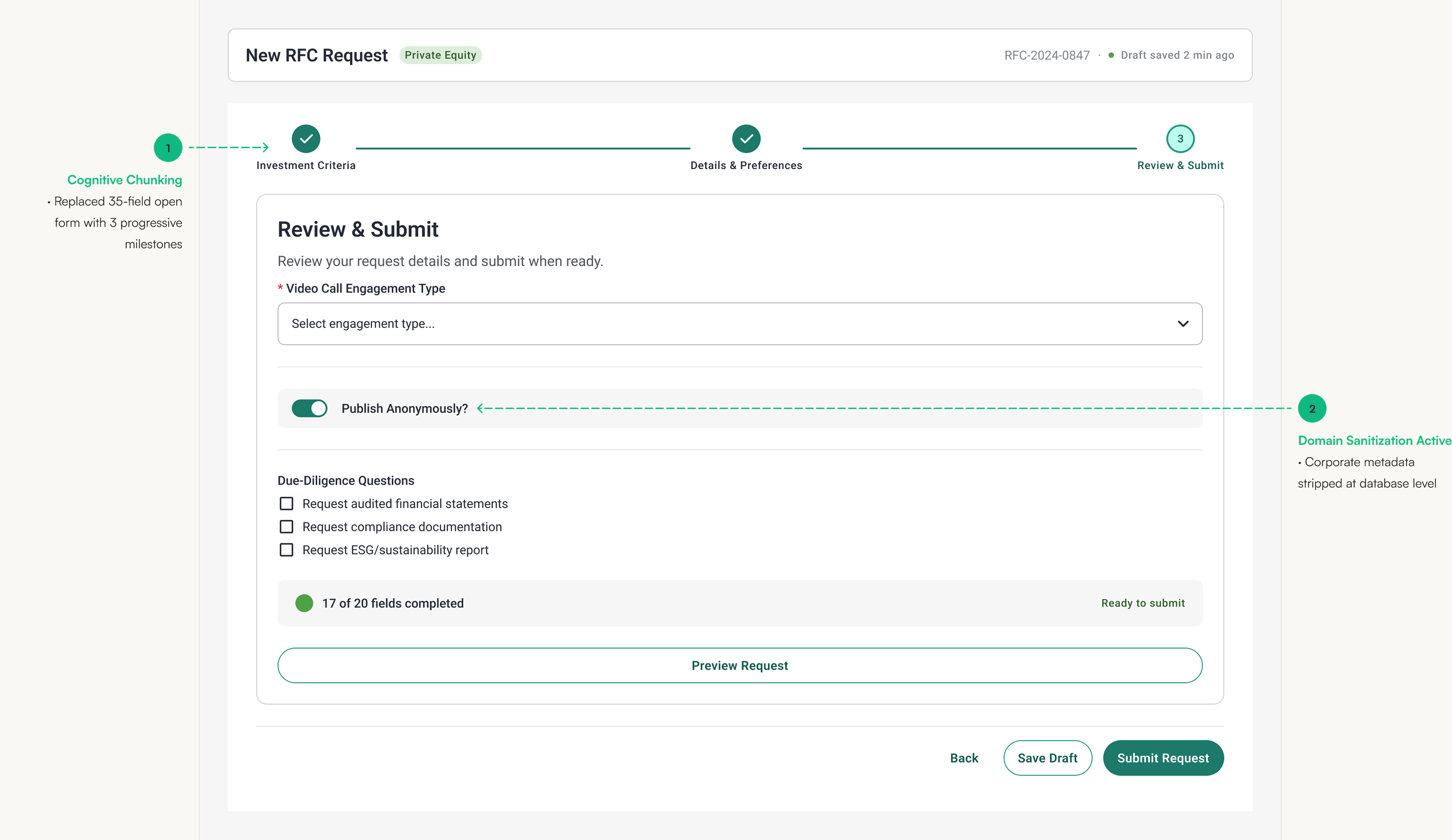
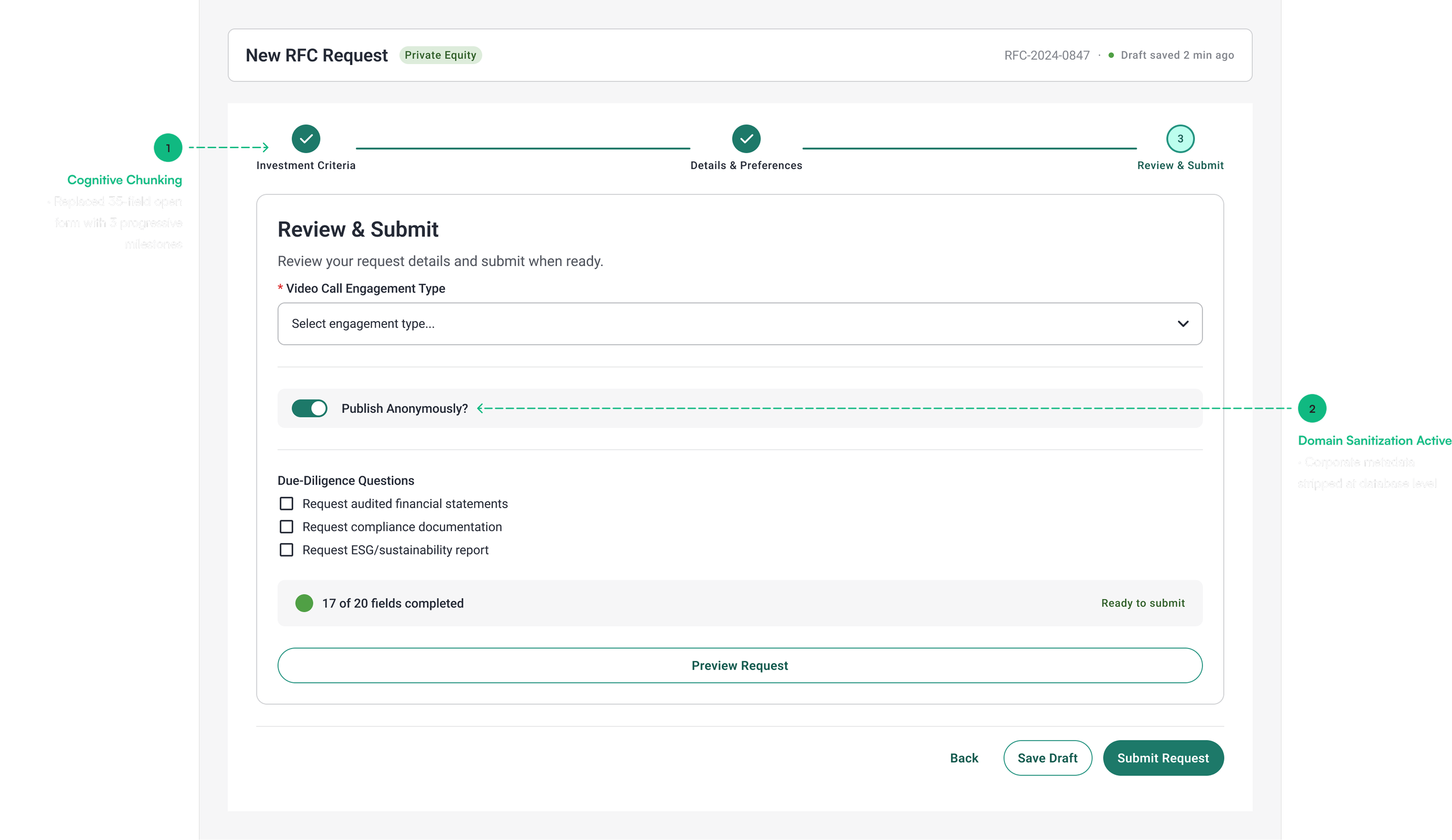
01 · Cognitive Chunking
3-Step Progressive Wizard
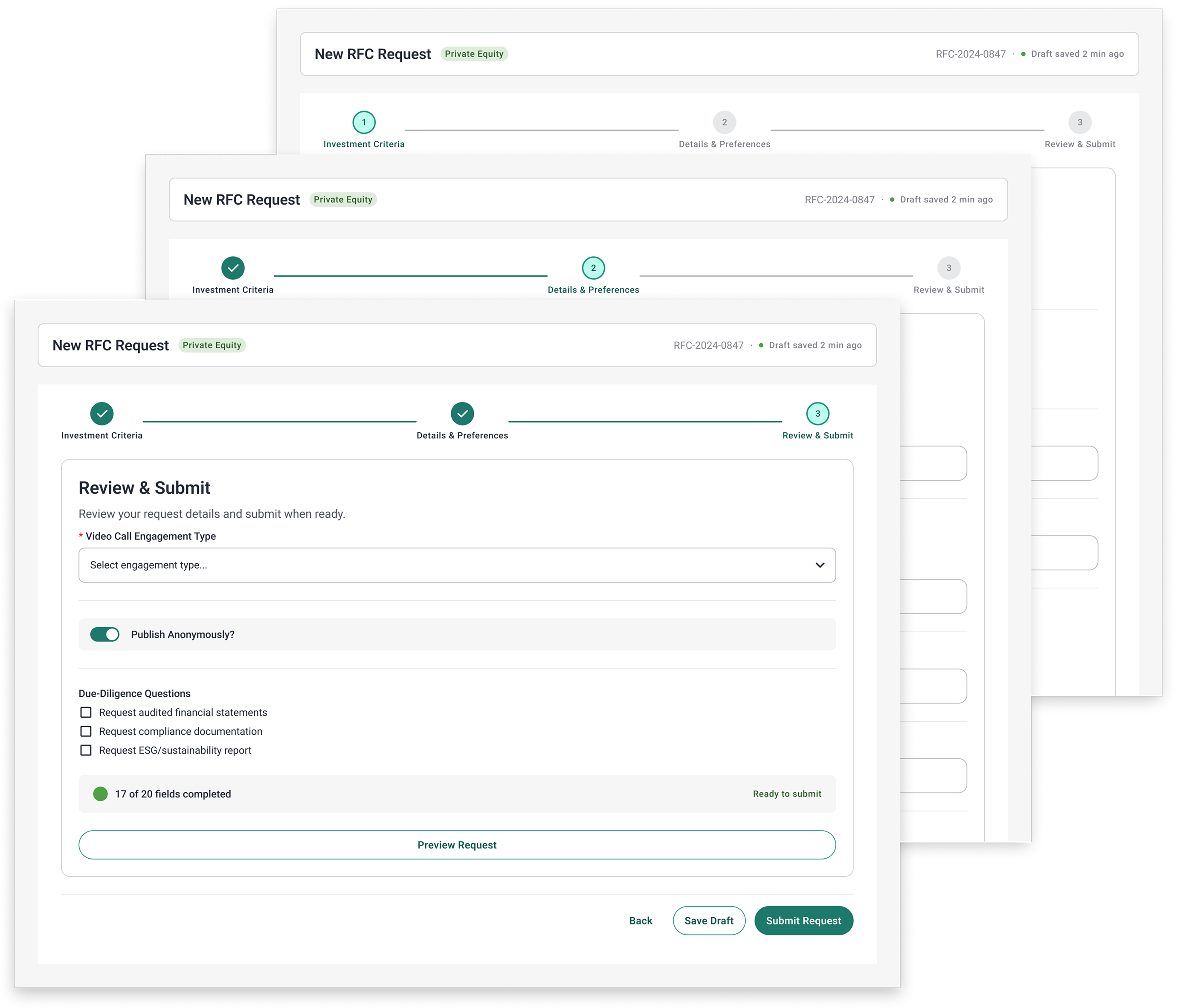
Replaced an overwhelming 35-field open form with 3 structured milestones (1. Investment Criteria, 2. Scope & Horizon, 3. Governance & Anonymity).
02 · Domain Sanitization
Automated Privacy Layer
Engaging the “Publish Anonymously” toggle automatically strips corporate branding and email domains at the database level, displaying only verified technical specs to prospective vendors.
03 · Validated Impact
Measurable Outcome
Form completion time dropped from over 30 minutes to under 3 minutes, with 100% parameter structured compliance across all live enterprise requests.
Intake Speed
< 3 MIN
Compliance
100%
INTERFACE BLUEPRINT·RFC Intake Engine
DEEP DIVE 02 · OPERATIONS DESK
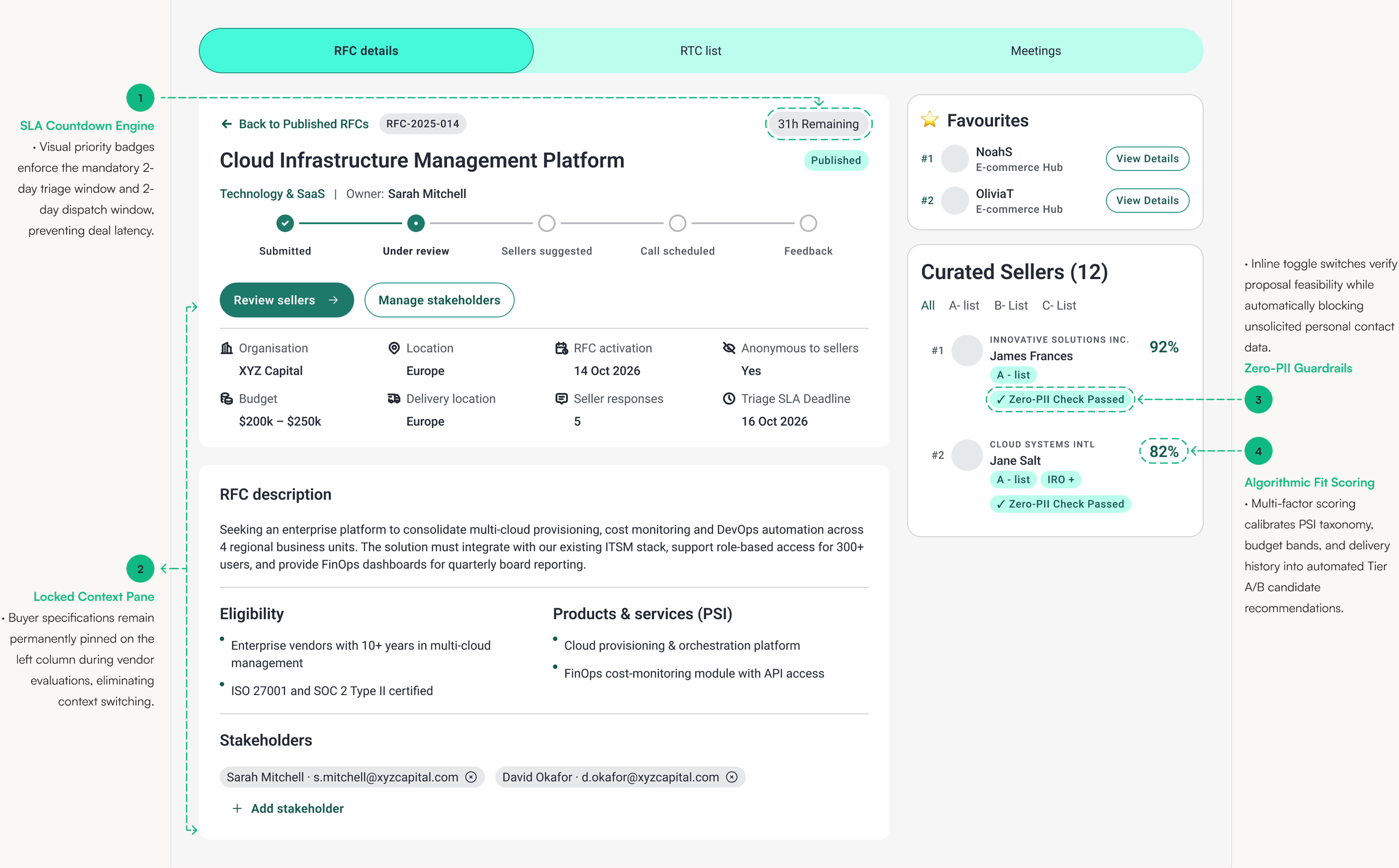
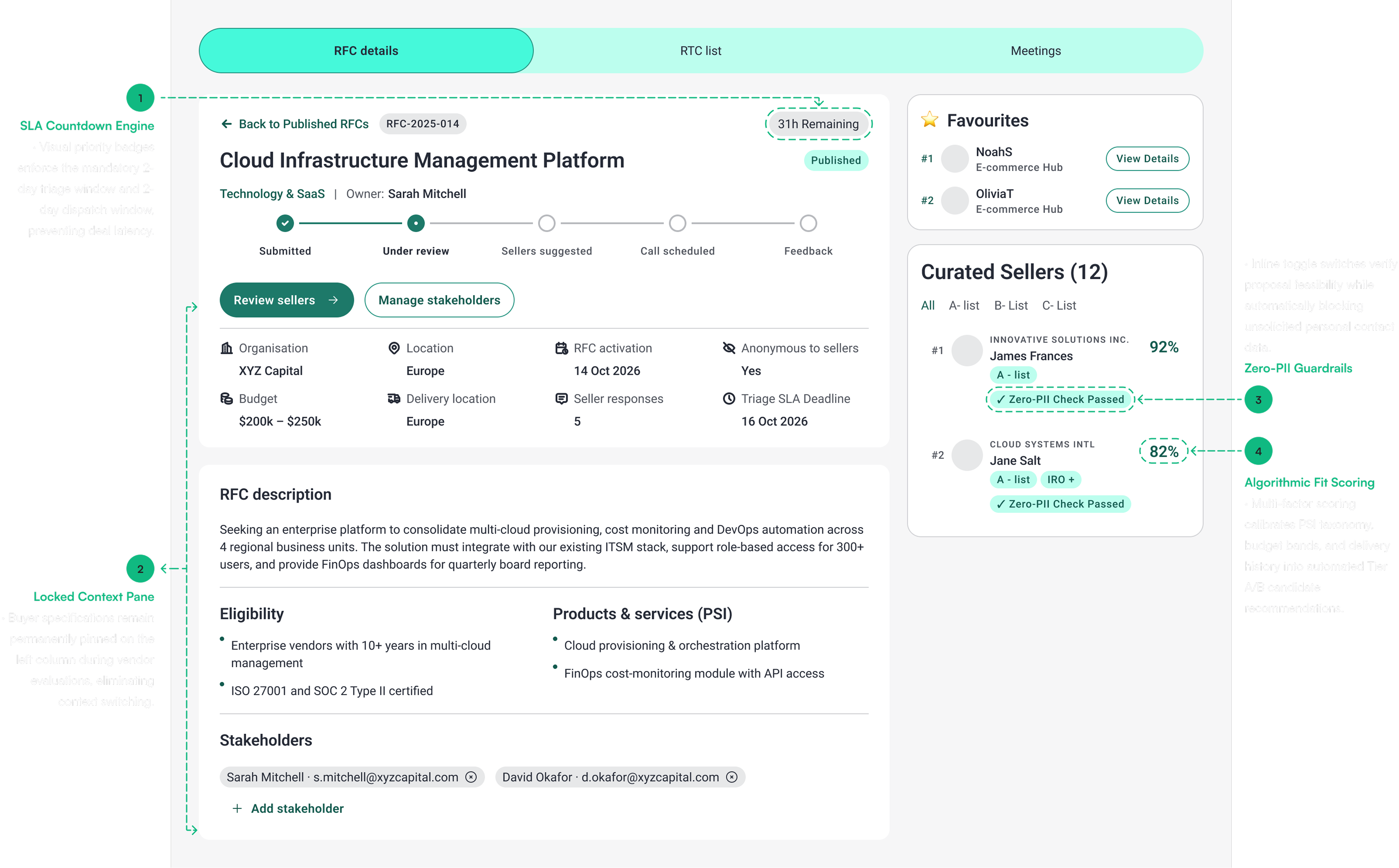
The Director Workspace & “2+2” SLA Engine
A high-density split-pane terminal designed to triage inbound demand, verify Zero-PII compliance, and orchestrate curated vendor matchmaking within a strict 4-day operational cadence.
01 · Cadence Enforcement
48h SLA Target
Replaced unmonitored email follow-ups with an active countdown state machine. Priority countdown timers enforce a strict 2-day internal triage and 2-day vendor response window, preventing back-office bottlenecks and deal staleness.
02 · Dual-Custody Audit
Zero-PII Gatekeeping
Built-in compliance checkpoints require Directors to manually verify regulatory filings (ISO 27001 / SOC 2) and scrub identifying metadata before dispatching proposals, ensuring enterprise buyers remain completely anonymous during discovery.
03 · Validated Impact
Operational Velocity
Evaluative workflow simulations confirmed the split-pane workspace eliminated cross-tool context switching, collapsing deal matching latency from a 30-day baseline to under 48 hours while maintaining high curation quality.
Match SLA
< 2 DAYS
Precision
> 70%
INTERFACE BLUEPRINT·Director Operations Desk
Iterative Pivots & Edge Cases
Designing Through Failure: Tested Hypotheses & Strategic Pivots
Enterprise systems are defined by edge cases and operational friction. Rather than executing a linear path, each core workflow went through rigorous evaluative testing, cross-functional engineering reviews, and discarded directions to arrive at production viability.
The Architectural Trade-Off & Pivot Matrix
| Exploration Track | Initial Hypothesis | Discovered Failure Mode | UX Pivot Implemented |
|---|---|---|---|
| Form Factor Evolution | A single-page form with 18 fields would minimize clicks after pruning 17 redundant legacy fields. | Usability testing showed an 18-field single page caused cognitive fatigue and high drop-offs. | Progressive Intake Wizard: Chunked into a 3-step progressive model, cutting submission time to < 3 minutes. |
| Landing Dashboard Architecture | Leading with aggregate analytics charts would provide high-level strategic value. | Testing revealed executives found passive charts useless; they needed immediate operational clarity. | Action Command Center: Redesigned into a task-oriented portal prioritizing triage queues, state machines, and active meetings. |
| Pipeline Visibility | Standard status labels inside tables would sufficiently communicate deal progress. | Users continued emailing reps because table badges didn't show where deals stalled in review. | Pipeline State Machine: Implemented an interactive timeline tracking touchpoints from triage to confirmed calendar booking. |
| Internal Data Fragmentation | Directors could reference auxiliary CRM tools alongside the portal during review. | Caused duplicate records, missed SLAs, and conflicting vendor statuses across internal teams. | Single Source of Truth: Partnered with data engineering to map portal actions directly into the 14M-record core database. |
| Supply-Side Liquidity Fallback | All incoming buyer RFCs would find an immediate Tier A match in the database. | Niche requirements occasionally returned zero Tier A vendors in specific regions. | Supply-Side Sourcing Loop: Built an automated fallback routing custom requirements to sales teams to onboard vendors under temporary access. |
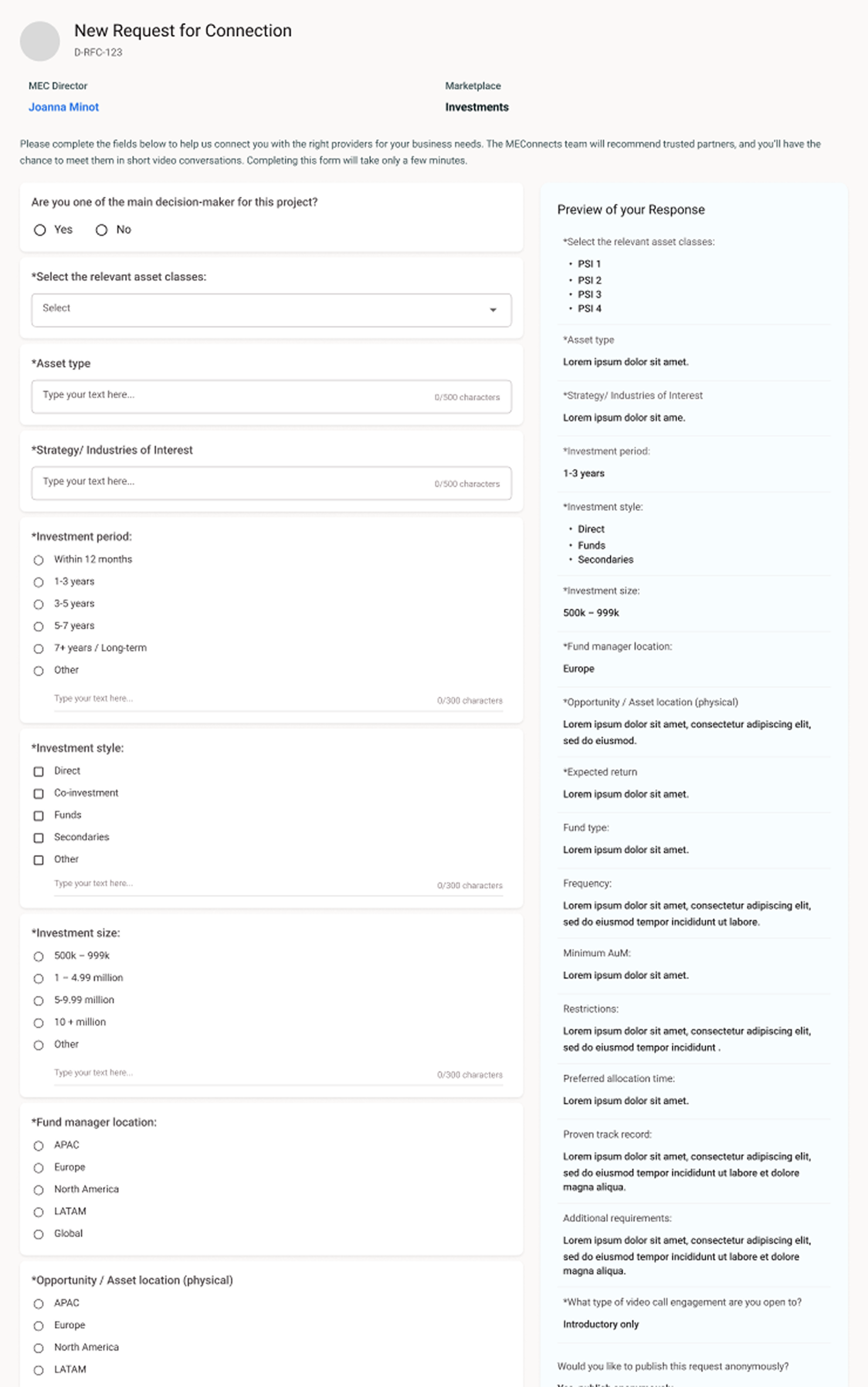
× Discarded: 18-Field Monolith
- 42% Drop-off before submission
- Unstructured free-text inputs
- Forced corporate identity leak
✓ Adopted: 3-Step Progressive Flow
- 96% Usability task completion
- Constrained token chips (14M Database)
- 1-Click “Publish Anonymously”
System Resilience & Trade-Offs
Strategic Trade-Offs & Technical Realities
Enterprise systems cannot be designed in an ideal vacuum. Scalable UX requires balancing executive stakeholder pressure, legacy database constraints, and cross-portal operational costs.
GOVERNANCE VS. OPEN BIDDING
Rejecting Unmoderated Open Bidding
✕Discarded: Open-Market Bidding
Public RFCBuyer Identity Exposed
Open BidsUnmoderated Vendor Applications
Noise & Leaks78.4% Abandonment
✓Production: Governed Concierge Gate
Anonymous RFCTokenized & Sanitized
Director TriageDual-Custody Compliance
Curated Match<2 Day Turnaround
The Conflict & Discovery
Stakeholder Pressure: Commercial stakeholders lobbied for an open-market bidding model where any seller could directly apply to active buyer RFPs to maximize top-of-funnel transaction volume.
Evaluative Finding: Audits revealed that public RFPs directly triggered the 78.4% privacy deficit. Enterprise buyers refused to expose strategic roadmaps and budgets openly, resulting in 30-day blind-bidding stalls and 68.5% deal leakage into offline email backchannels.
The Systemic Decision
UX Decision: Completely eliminated public boards and open vendor applications. Replaced open bidding with an internal Director Curation Gate, enforcing buyer anonymity and requiring compliance verification before introductions occur.
Systemic Outcome: Eliminated blind-bidding noise, lifted curation accuracy above 70%, and gave enterprise executives the legal and privacy confidence to conduct end-to-end procurement on-platform.
DATABASE CONSTRAINTS & LATENCY
Decoupling Submission Speed from Database Calculations
✕Discarded: Synchronous Blocking Execution
Submit RFPFull Form Payload
Blocking Spinner2.8s DB Query
System Hang34% Abandonment
✓Production: Asynchronous State Machine
Instant Stage<200ms Ack
Async QueueBackground Match
Live Status TrackerProgressive Trust
The Conflict & Discovery
Technical Constraint: Executing real-time algorithmic matching against the legacy database of 14 million historical records introduced a 2.8-second server-side calculation lag during RFP submission.
Evaluative Finding: Usability testing demonstrated that blocking UI spinners caused a 34% drop-off rate. Enterprise executives interpreted the multi-second hang as a system stall or unhandled database exception rather than an in-progress computation.
The Systemic Decision
UX Decision: Completely decoupled frontend ingestion acknowledgment from backend calculation. Designed an optimistic confirmation flow that acknowledges parameter receipt instantly (<200ms) and routes the user to a dashboard state machine while delegating matching computations to asynchronous background queues.
Systemic Outcome: Eliminated submission abandonment and introduced real-time state chips (Received → Algorithmic Scoring → Director Review), transforming a backend latency constraint into a visible signal of thorough operational rigor.
DESIGN SYSTEMS AT SCALE
Multi-Portal Cohesion Through Semantic Tokens
✕Discarded: Bespoke Portal Styling
3 DisconnectedUI Libraries
Fragmented SpecsRedundant Code
Maintenance Debt74% Visual Drift
✓Production: 420-Token Semantic Architecture
Token PrimitivesColor, Space, Elevation
Semantic AliasesRole & State Maps
Unified EcosystemBuyer · Seller · Admin
The Conflict & Discovery
The Operational Constraint: Delivering three distinct environments—the Buyer Portal, Seller Hub, and Director Triage Desk—risked tripling frontend engineering overhead and introducing severe UI drift across releases.
Evaluative Finding: An audit of 120+ proposed screens revealed that 74% of core interactive patterns (data tables, document approval drawers, status indicators) shared identical functional logic despite distinct persona views.
The Systemic Decision
UX Decision: Engineered a centralized design system built on a 420-token semantic tier (primitive → semantic → component). Decoupled component geometry from persona-specific theming so all portals share a single source of truth.
Systemic Outcome: Accelerated frontend velocity by eliminating redundant component styling, ensuring 100% interface consistency across all three portals while reducing design-to-code maintenance debt.
Measurable Business Impact
Quantified Enterprise Outcomes
Grounding the MEConnects platform in structured parameter capture, role-based governance, and centralized operations transitioned an unmoderated directory into an enterprise SaaS ecosystem, delivering measurable operational leverage across all three user roles.
SUBMISSION VELOCITY
< 3 MIN
Baseline: 30+ min──►Production: < 3 min(-90% Friction)
Replaced a monolithic 35-question form with a 3-step progressive ingestion wizard and tokenized input parameters, eliminating cognitive fatigue and form abandonment.
DEAL CYCLE VELOCITY
< 2 DAYS
Baseline: 7–30 days──►Production: < 2 days(15x Faster)
Decoupled database calculations and introduced internal Director triage desks to eliminate multi-week blind-bidding stalls and vendor response latency.
CURATION RELEVANCE
> 70%
Baseline: < 20%──►Production: > 70%(+50% Gain)
Constrained UI taxonomy directly feeds the backend matching engine schema, ensuring sellers only receive high-intent, pre-qualified RFPs.
ON-PLATFORM RETENTION
100%
Baseline: 68.5% Leakage──►Production: 100% Tracked(Closed Loop)
Integrated compliance document signing and direct meeting scheduling into the portal UI, closing the offline email backchannel and giving leadership complete pipeline visibility.
Want more? Explore other case studies!